Clint Burnham
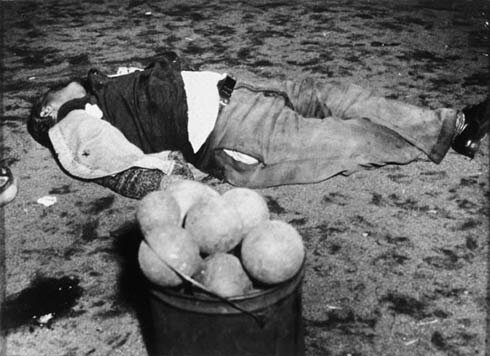
Friendly Game of Bocci, c. 1939
Collection of Alan and Ellen Newberg
© Weegee/International Center for Photography/Getty Images
WEEGEE AND FILM NOIR
CLINT BURNHAM
From a talk at SFU Gallery June 3, 2006 with Chris Brayshaw and Bill Jeffries
“Nothing is more common than the notion that in history up till now it has only been a question of ‘taking.’ The barbarians ‘take’ the Roman Empire, and this fact of ‘taking’ is made to explain the transition from the old world to the feudal system. In this taking by barbarians, however, the question is, whether the nation which is conquered has evolved industrial productive forces, as is the case with modern peoples, or whether their productive forces are based for the most part merely on their association and on the community. Taking is further determined by the object taken. A banker’s fortune, consisting of paper, cannot be taken at all, without the taker’s submitting to the conditions of production and intercourse of the country taken. Similarly the total industrial capital of a modern industrial country. And finally, everywhere there is very soon an end to taking, and when there is nothing more to take, you have to set about producing.” Marx and Engels, The German Ideology, 1848
“It was a $300 assignment, with me keeping the resale rights, so I decided that I had better help the realism along.” Weegee by Weegee, p. 118
Weegee, the Ouija board, the photographer who was never bored, what did he do? Not, who was he, but how did he take these photographs? I think that our vernacular, our (over)use of the verb “take” for shooting a photograph – or even our word “shoot” – are all germane here, in a consideration of how and what Weegee was doing. He took pictures, he shot photos, he got the shot, he was not so much a flâneur as a thief, a pickpocket. Someday someone will remake Robert Bresson’s Pickpocket but as the biography of Weegee, and we will see Weegee arguing with the police about getting access to the body, the hoodlum, the drag queen – even if, from the evidence of his photos, he never had to argue, he was always there, ahead of time even, occasionally (notably his photo of a tramp on the lower east side, which is followed by a shot of the tramp after being hit by a taxi).
Weegee’s photos may be documents, they may document New York, or the urban, or the abject, or the underclass, or the night life, or the social contradictions, but they do this as something he has taken away. He takes away the possibility of the woman and daughter ever doing anything but look up, in horror/grief, as they watch their relatives die in a fire. He takes away from the grief-stricken, from the ignominious corpse, a semblance of dignity.
“Taking” is a mistake for “making” in a strict literal sense: a photographer makes a picture, he or she doesn’t take it from anything or anyone. And yet our vernacular conveys a deeper truth, or the kernel of the truth, not unlike so-called primitive beliefs that the picture steals one’s soul. This is why his book is called The Naked City: for Weegee has taken the clothes off the inhabitants – the clothing not just of wood or cotton but of hypocritical morality, or ideology.
In The Naked City, Weegee comments that he would print his pictures of ethnic white New Yorkers as pale and pallid as possible, for Italians and Jews liked that corpse look.
From Weegee by Weegee: “I would finish the photographs on the contrastiest paper I could get in order to give the kids nice white, chalky faces. My customers, who were Italian, Polish or Jewish, liked their pictures dead-white.” Weegee was just 18 then.
But what of this process of moving from taking to making. I began with the quotation from Marx and Engels’ German Ideology because of how they criticize the notion of history as just the record of plunder and pillage, arguing that at some point production as well as to occur. The means of production must be seized. But this shift is ambiguous in Weegee’s work, for it happens in two ways: one, his furtive rearrangement of bodies or casting of actors for his pictures (which leads to film noir), and the other, his sometimes interesting, sometimes disastrous experiments with the distorted image.
It is the notion of a transition to film noir that I would like to focus on. The relationship between Weegee’s photos and film noir seems to be self-evident: both focus on the city, on the night, on the criminal and underclass, on sexual relations, and are in black-and-white. The differences seem only to be two: Weegee’s photographs are still, of course, and film is a moving picture; and Weegee documented New York while film noir makes it up. Weegee takes, film makes.
These differences, however, can be quickly dealt with: do we now know, after all, film noir (and not just film noir) as much through still images (which are usually not stills from the film stock itself but production stills shot on the set)? And does Weegee’s photography not, after all, embody a degree of making as much as of taking. Indeed, I would like to argue that Weegee’s photographs are making whenever they are taking, that it is not just his distorted shots that anticipate digital photography and PhotoShop, but much of the classical period – the 1930s and 1940s – of his work.
To argue this further, I would like to focus on one of Weegee’s techniques, that of turning from the horrific object – the burning tenement, or the mangled car – to the reaction of the subject. This is most notorious or notable in the picture he later labelled “Grief,” the photograph of the mother and daughter watching their building burn down, with the woman’s two other children inside. Weegee remarks that he cried when he took that photo. This turning away from the disaster, to the family’s reaction shot, is where Weegee moves from taking to making. For now he is creating a subjectivity, a forlorn grief, that is motivated by an absence: we do not see what they see. But we cannot, for what they are seeing is not simply the burnt building, but itself an absence, the absence of their family.
If we continue to look at this picture, two more details emerge. One is that the daughter herself is looking at us – or, rather, looking at the camera, or looking at Weegee make the shot. Her face is swollen with grief, with the physiognomy of crying, she holds her mother with one arm around her, her coat is buttoned up. And the mother herself has a scarf or a blanket around her head, her hand clutching it, the wedding ring visible. If we look at the daughter, she looks back at us; if we look at the mother, she looks up, away from her living child, towards her dead ones.
Such reactions are a bit different from those of two other pictures: one of a woman who has just found out that she killed someone in a car accident, and that of a wife whose husband has just been killed in a bocce game. The driver’s mouth and eyes are open, a flower incongruously in her hair. She looks off camera, again, at what is not there, which is not the other vehicle, but her existence thus far. Too, the bocce victim’s wife, her lips pressed together grimly, leans back, restrained or supported by the cops.
Three women – four women – learning that they can kill, or that their family can die. This, finally, is the femme fatale of Weegee’s making: a radical subject that confronts its own kernel of being, its core of agency: to take a life, to have a life taken, to make a life. This subject that Weegee makes is, to use Marx’s words again, an active, living subject, that selfsame subject as we find it in film noir, a subject constituted around an absence, a hollow core.
Clint Burnham is a Vancouver writer. His criticism and poetry have appeared recently inakimbo.biz, f-hole, Pyramid Power, the Vancouver Sun, and UE. “Leviathan,” an essay on Brian Jungen, will appear this fall in a publication from the Witte de With in Rotterdam.