Doppelganger Magazine >> Issue Six | June 2006
:::::::::::::::::::::::::::::::::::::::::::::::::::::::::::::::::::::::::::::::::::::::::::::::::::::::::::::::::::::::::::::::::::
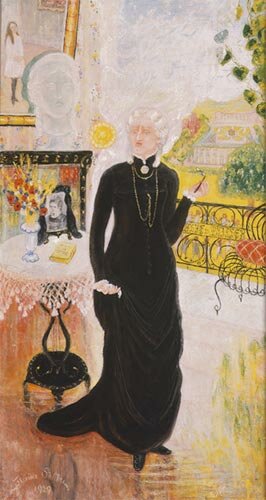
Florine Stettheimer, Fraulein Sophie Von Prieser, 1929.
NOTES ON A PICTURE
MATTHEW STADLER
The pleasure of a small museum is that there is so little to look at. The Portland Art Museum (if one ignores its new Jubitz Modern and Contemporary art wing) still delivers the charms of a modest collection housed inside its original, jewel-like Pietro Belluschi building. A hodge-podge of unremarkable works fills out a flat sea, surrounding a few islands of superb art, most of them paintings. Painting has always been the Portland Art Museum’s favorite child. They have Albert Bierstadt’s stirring and absurd fantasy of nearby Mount Hood, painted in his Hudson River studio in 1869. Bierstadt has turned the mountain 90 degrees, so that its symmetrical West face can be seen surmounting the great Columbia Gorge and several attractive cataracts that, in dull life, lie to the mountain’s north. There is also a lovely Josef Albers, Late Reminder (1953), a smallish canvas in which a red square with purple geometric penumbra sits deep in a field of blue. This hangs near a remarkable painting from 1943 by Maude Kerns. Who is Maude Kerns? Google tells me she was born in Portland in 1876 and died in Eugene, Oregon in 1965. (And I see that Terri Hopkins, who curates the Art Gym at Marylhurst, in Portland, has included her work in several shows.) Kerns’s serenely banded rectangle of blue (which slips from pale to slate to cerulean to aqua in a most beguiling, composition of blended horizontal bands) is broken by a trio of geometric figures (including a small black ball and a collision of triangles and spheres that hovers somewhere between the 1939 World’s Fair emblem and a prescient icon for Ms. Pac Man), and seems informed equally by Malevich, Kandinsky, and (I know its impossible) Susan Frecon. This is a beautiful, unlikely painting, apparently birthed in the WPA program.
But my favorite painting at PAM is Florine Stettheimer’s 1929 portrait of her childhood governess, Fraulein Sophie Von Prieser. One can easily spend an hour with it, enjoying the solitude of an otherwise empty gallery without the distraction of too many great works nearby. The painting centers on the standing figure of Fraulein Von Prieser, rendered with a Rousseau-like flatness and hauteur, a pear-shaped action figure stabilized by a great glob of dress that makes a third leg to balance the two, narrow black feet protruding from the dress’s front.
The painting is several paintings: There are four portraits (one of them, the mirror reflection of the girlish acolyte, Florine, gazing in admiration at her cherished governess—our view appears to be hers); a formal landscape; a still life of flowers on a side table; a scrim of lace (the most convincing illusionist surface in the painting); and all of these are immersed within a kind of overall color-field painting, its quarters ranging from pale blue to deep umber to sharp green (and echoed in reverse in a more geometric composition of the same colors in the tile face of the fireplace). A book on the table is titled “Ansichten Von Stuttgart.”
As with Rousseau, we get a lot of information. The cut of Fraulein Von Prieser’s dress, its buttons and lace, are exact; a talented seamstress could easily recreate the dress from the painting. Similarly, the flora are specific (poppies and forsythia on the side table; morning glory and a chestnut tree outside) and rendered at a specific time of year (early summer). The furnishings—the harp-shaped pedestal to the round side table, its lace doily, a bent wire chair, the wrought iron balcony with its Gothic-scripted “Sophie V. Prieser”—are as precise and mimetic as the color fields are abstracted and fanciful. In the beautifully detailed lace, falling across the upper left half of the open French doors, this tension between illusion and materiality becomes especially pitched. The wildly variegated whole is pulled together and unified by the gravity of the black hole at the center—the elongated figure of Fraulein Von Prieser in her severe dress—a void that sucks at every corner of this colorful smorgasbord.
Stettheimer has given her beloved teacher a horsey jaw and Thomas Jefferson’s brow, and fussed over the details of her face enough to make a hash out of the skin and coloring. Von Prieser’s right arm descends uncomfortably far, the pale hand upturned in a gesture that looks obscene, a ball-grabbing threat such as one might expect from Don Corlione. In her other hand she holds her pince nez away from her face, her mouth curling downward in a disapproving scowl. However adoring the girlish Stettheimer in the mirror is, her black-clad mistress is that much dismissive, perhaps disgusted by, the white-smocked student.
The largest head in the painting, the dominant portrait, is a grossly oversized Hellenic bust on the mantle, outsizing the full-body of Stettheimer in the mirror beside it, and more than doubling the size of Fraulein Von Prieser’s own foregrounded head. Its marble is as clear and smooth as the face of Fraulein Von Prieser is hashed and gashed. Whatever pas de deux of attraction and repulsion is transpiring between mistress and student, this older, wiser face gazes serenely, eyeless, through that distraction, at us. Thus, the Portrait of Fraulein Sophie Von Priesser presents two simultaneous relationships: the temporary, eventful one of Florine Stettheimer and her commanding mistress; and the eternal, unchanging one of Hellenic beauty and its viewer.
Out in the landscape (a closely shorn meadow that opens off a formal, collonaded garden), a dozen schoolgirls stand in a ring holding hands. Their circuit is complete, closed, as is the charged gap between girl and governess. Not so the clear gaze of Hellenic beauty. It awaits us. .
Matthew Stadler is a novelist (Landscape: Memory, Allan Stein) and editor and cofounder of Clear Cut Press. His writing appears in Domus, Frieze, Artforum, Dwell, The Stranger, and many other publications.